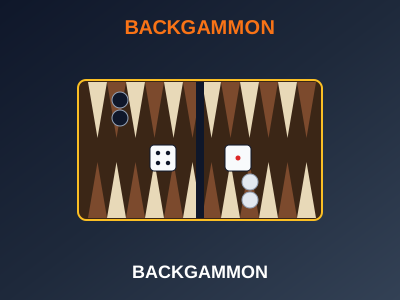
 Strategy
Backgammon
Play Backgammon against the computer. Roll the dice, race your checkers around the points, hit blots, and bear off all fifteen first.
MediumWeb game
26 games
Strategy games are where the SonoTap arcade slows down and asks you to think several moves ahead. There's rarely a time pressure here; instead there's an opponent — human, computer, or the game itself — and a board full of decisions where the better plan tends to win.
This section is anchored by the board-game classics: Chess, Checkers, Go, Reversi, Gomoku, Connect Four. These are games humanity has spent centuries refining, and their rules fit on a screen as neatly as on a table. You're trading pieces, controlling space, and setting traps.
Alongside them sit territory and placement puzzles like Hex and Color Flood, where the "opponent" is the geometry of the board, and a handful of lighter planning games where you're managing limited pieces or moves toward a goal.
The pleasure of a strategy game is different from an arcade blast. A bad move doesn't end the game — it quietly costs you position, and ten moves later you understand why. That delayed feedback is what makes these games deepen with repeat play: the more you lose, the more you start to see the shape of a winning position before you've built it.
Because they don't rely on reflexes, strategy games also adapt gracefully to whoever's playing. Play them against a phone AI on the train, or sit at a laptop and actually calculate.
If you want depth that scales for a lifetime, start with Chess or Go. For something you can learn in a minute and still be improving at in a year, try Reversi or Gomoku. Every game page lists the rules in plain terms and flags where the common beginner mistakes hide.
Bring patience, not speed.
Most of these are played against a built-in opponent rather than another person, which has its own advantages. You can pause mid-position, walk away, and return to a board exactly as you left it; many of the pages let you undo a move and try a different line, which turns a loss into a lesson rather than a dead end. The computer plays at a fixed level, so once you can beat it consistently you know you've genuinely improved — and you can graduate to the heavier games in the section with a real foundation underneath you.
StrategyPlay Backgammon against the computer. Roll the dice, race your checkers around the points, hit blots, and bear off all fifteen first.
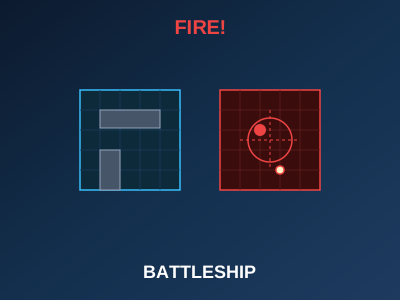 Strategy
Play Battleship. Position your fleet on the grid, fire on enemy waters, and sink every rival ship before they sink yours.
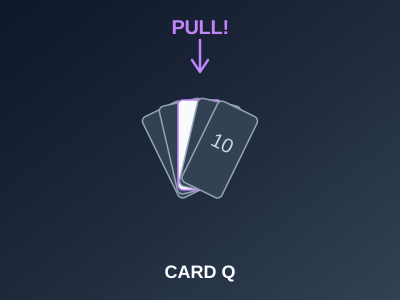 Strategy
Play Card Q. Tap at just the right moment to pull out a card in a quick, addictive one-button test of timing and nerve.
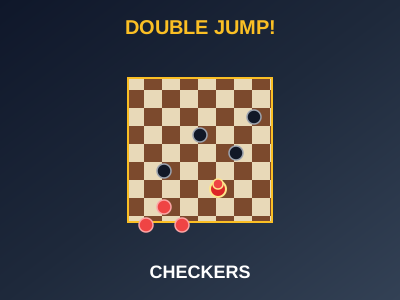 Strategy
Play classic checkers (draughts) against the computer — jump your opponent's pieces and crown your kings to win.
 Strategy
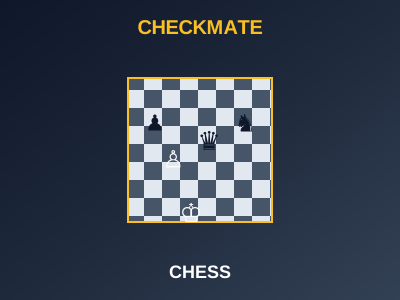
Play classic chess against a smart computer opponent on a clean, responsive board with full legal-move rules.
 Strategy
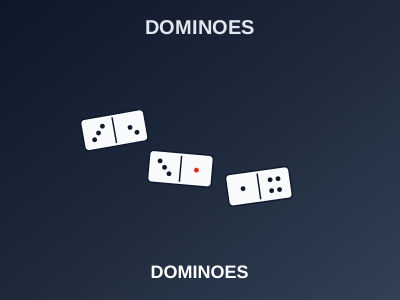
Play Dominoes with a double-six set. Match the pips on your tiles to the ends of the chain and empty your hand before the computer.
 Strategy
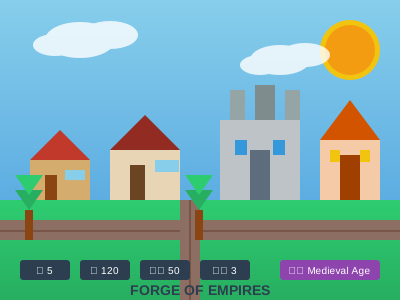
Build your empire from the Stone Age to the modern era in this strategic city-building game.
 Strategy
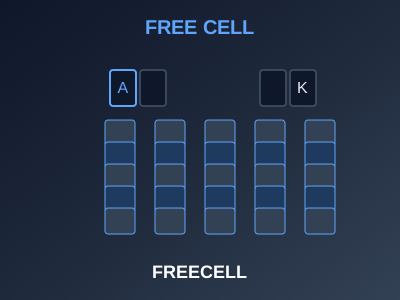
Play FreeCell solitaire with every card face up from the start. Use four free cells to build the foundations and solve almost every deal.
 Strategy
Be first to line up 5 stones in a row on this 15×15 board against a tactical AI.
 Strategy
Play Hearts against three computer rivals. Avoid taking hearts and the Queen of Spades, or shoot the moon and dump them all on foes.
 Strategy
 Strategy
Play Spider Solitaire with two decks. Build cards down across ten columns and clear a suit from king to ace to remove it from the table.
 Strategy
Mine copper with drills, route ore on conveyor belts into ammo and power, wall up turrets, and survive timed enemy waves in an open-source automation tower-defense RTS.
 Strategy
An open-source isometric city builder where you zone residential, commercial, and industrial tiles, lay roads that auto-connect, and watch traffic and population grow.
 Strategy
Spend plasma to materialize a squad of hex-grid creatures before a no-RNG turn-based duel, where each unit's four abilities and nine stats decide the fight.
 Strategy
Place firewalls, load balancers, caches, and databases like defensive towers in a Three.js cloud simulator, routing color-coded web traffic and absorbing DDoS waves.
 Strategy
An HTML5 rewrite of Panzer General II: a turn-based hex wargame where combined-arms stats, unit facing, and terrain on each hex decide whether a front holds or breaks.
 Strategy
On an 11x11 board, 24 attackers hunt a king and 12 Norse defenders; the king wins by reaching any corner, attackers by surrounding him on all four sides.
 Strategy
Command forty-plus pixel units across a tile grid where each attack triggers a counterattack, so positioning and first strikes decide whether a step becomes a rout.
 Strategy
A handwritten JavaScript port of Micropolis, the open-source 1989 SimCity, that ticks a real city simulation beneath zones you draw with roads, power lines, and a budget.
 Strategy
A Three.js 3D city builder where each zoned tile extrudes into a live skyline, powered by a micropolisJS simulation running in a Web Worker, with budget, overlays, and disasters.
 Strategy
Assemble a party of heroes for turn-based squad battles on a hexagonal dungeon grid; carry survivors deeper each level and spend earned gold to recruit reinforcements.
 Strategy
Spend action points each turn to attack adjacent fields, raise barracks and mines, and topple rival townhalls in a free open-source Risk-style conquest for up to sixteen players.
 Strategy
Cube Engine is a browser voxel sandbox that software-renders a Minecraft-style world on HTML5 canvas, letting you place and remove blocks across endless procedural terrain.
 Strategy
Found cities with settlers, climb a branching tech tree, and grow a stone-age tribe into a space-faring empire in this open-source turn-based 4X, playable in any browser.
 Strategy
A solo, AI-driven take on Werewolf: one human joins a table of reasoning, bluffing AI players, voting each day to expose hidden wolves before the pack thins the village by night.