 Strategy
Frontier Command
Harvest crystal, build power plants, barracks and a war factory, and send riflemen, rocket troops and tanks to flatten the enemy command hall before it flattens yours.
MediumPlays here
SonoTap guide
Compare three RTS browser games by their actual mechanics and goals. Read practical strategy, learn the differences and choose your next session.
StrategyHarvest crystal, build power plants, barracks and a war factory, and send riflemen, rocket troops and tanks to flatten the enemy command hall before it flattens yours.
 Strategy
Assign villagers to berries, trees and rocks, grow your population with houses, research Age III for knights, and raze the enemy town center before its raids raze yours.
 Strategy
Hold three steel-pumping islands, build destroyers, stealth submarines and plane-launching carriers, and sink the enemy harbor before their fleet sinks yours.
Looking for games like Command & Conquer or Age of Empires usually means looking for a decision rhythm: establish income, turn it into production, survive pressure and choose a counterattack. These three independent browser games compress different parts of that rhythm. Frontier Command asks when one resource should become another fighting unit. Settler Trail asks how workers, housing and three materials should support one another. Iron Tide puts income on contested islands, making fleet position an economic decision. These are editorial comparisons of mechanics, not official versions of those franchises or promises of their full campaigns, multiplayer and modding systems.
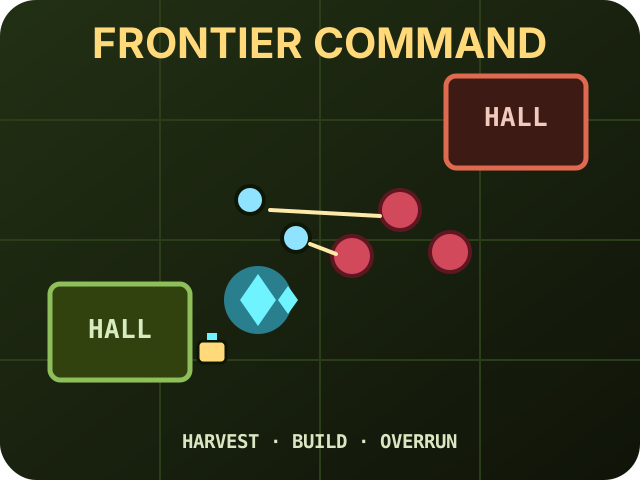
Frontier Command squeezes a classic base-building real-time strategy match onto one screen. Your command hall sits in the lower-left corner with a single harvester already shuttling crystal home; the enemy hall, power plant, and barracks mirror you in the upper-right. Crystal is the only resource, so every decision is about timing: a second harvester pays for itself in three trips, a power plant accelerates all training by 25 percent and unlocks the war factory, and barracks turn credits into rifles and rocket troopers while the factory rolls out tanks. Every half minute the enemy launches a wave that grows with each cycle, and the AI keeps its own production queue running between attacks. Rocket troopers deal double damage to structures, which makes them the siege arm, while tanks anchor the push and rifles screen them. You win by leveling the enemy command hall; you lose the moment yours burns. A typical match runs four to seven minutes and the first crystal deposit lands within seconds of pressing start.
Spend your opening 250 credits on a barracks plus one rifleman rather than banking them: the first enemy wave arrives around the half-minute mark and an empty base cannot answer it. Queue a second harvester immediately after — the economy doubles and pays for the power plant that unlocks tanks. Mix rockets into every push once the enemy hall is exposed, because their doubled structure damage ends games faster than any tank duel. Keep your army between the crystal fields and your hall so raiders meet your guns before your harvester. When a wave warning appears, pull home, let buildings absorb fire while rifles pick off attackers, then counterattack the moment the wave breaks — the enemy base is weakest right after it spends everything on an assault. Finally, never leave fewer than two rifles at home; a single rocket squad slipping past your push can trade a hall for a hall, and the AI wins that race.
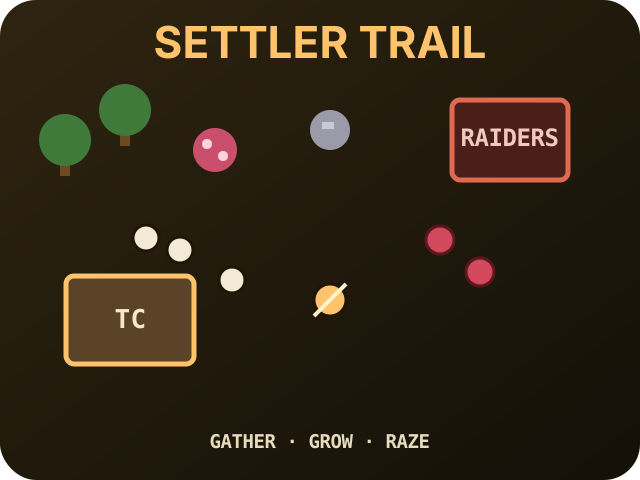
Settler Trail distills the classic village-economy real-time strategy loop into a single screen that plays in about five minutes. You open with a town center, one house, and five villagers, two of whom are already picking berries so food flows from the first seconds. Three resources drive everything: food trains villagers and soldiers, wood raises houses and the barracks, and stone feeds the Age III research that unlocks knights. Villagers are assigned by tapping a worker and then a berry bush, tree, or rock, and each trip hauls eight units of that resource back to the town center. Population is capped by housing, so every expansion decision competes with military production for the same wood. Across the map the enemy town center trains clubmen and launches raids that grow with every cycle, adding knights of its own from the third raid onward. Victory means reducing the enemy town center to rubble; losing yours ends the settlement. It is a build-order puzzle and a tug of war in one.
The first two minutes decide the match. Keep your initial five villagers on food until you can queue two more villagers back to back, because every worker pays for itself in under a minute and compounds from there. Shift to wood only when you are within 30 of a house or the barracks you actually need next, and never float stone before you are ready for Age III — it trains nothing early. When a raid warning fires, pull villagers near the town center and fight with clubmen under its shadow so raiders must divide their attention. Knights beat everything on the field, but a knight killed by five cheap clubmen is a losing trade, so screen them with your own clubmen and focus the enemy knights first. Once Age III lands, counter-raid immediately: the AI rebuilds slowly, and a raid timed right after you repel theirs often ends the game outright.
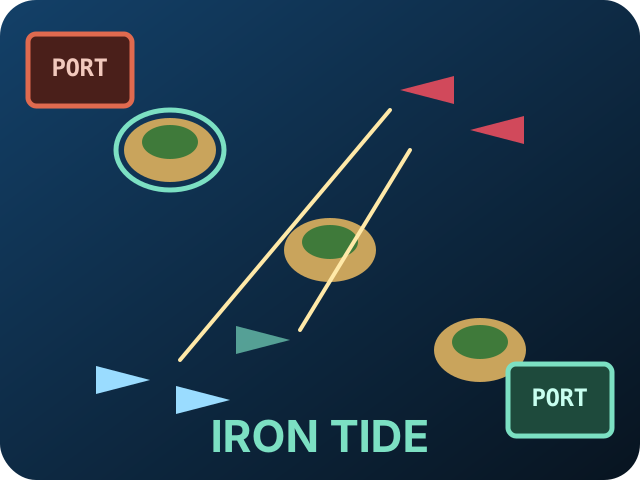
Iron Tide is a compact naval real-time strategy battle over a three-island sea. Your port in the lower-left and the enemy port in the upper-right each print a trickle of steel, but the real economy sits between them: park a ship near an island with no enemy contesting it and your steel income jumps by three per second, so map control literally builds your fleet. Three hull types form the counter triangle. Destroyers are fast, cheap screens and the only hull that reliably spots submarines at close range. Submarines hit hardest per shot and stay invisible until they fire or a destroyer closes in, making them the ambush pick. Carriers cost the most but launch planes that fly their strikes across a hundred and fifty pixels of open water. The enemy AI builds the same roster, contests islands, and periodically masses for a run at your harbor. You win by sinking the six-hundred-point enemy harbor; if yours goes down first, the tide goes out for good.
The opening race is for the center island: send your starting destroyer there before firing the engine on anything else, because the side that holds two islands for the first minute usually launches the first carrier. Build destroyers in pairs — a lone destroyer chasing a submarine reveal will eat a second torpedo before the first kill lands. Submarines win harbors: their seventeen-damage strikes arrive without warning, so once you have two, park them just inside torpedo range of the enemy port while your destroyers screen the approach lanes. Carriers are artillery, not brawlers — keep them behind your screen at maximum plane range and let the aircraft do the traveling. When the enemy masses for a harbor run, do not chase their raiders across the map; recall to the harbor, let its presence anchor your formation, and counter-attack the islands they abandoned to fund it.
Start with Frontier Command if you want a direct military production loop. After one opening, identify whether the bottleneck was collection, an idle queue or a counterattack that never happened. Choose Settler Trail when distributing labour interests you more than managing one currency. Choose Iron Tide when protecting a position should matter as much as winning an immediate fight.
Try one opening on the same device before comparing. On a small screen, check the selected unit before issuing a destination. Set a concrete goal such as keeping production running through a defensive wave. Survival time alone is a poor measure: every pick requires destroying the opposing centre. A shorter match won with a prepared attack can demonstrate more understanding than a long defence with no route to victory. The descriptions below explain each game's actual rules; none implies an endorsement or association with another publisher.