 Adventure
Critter Clash
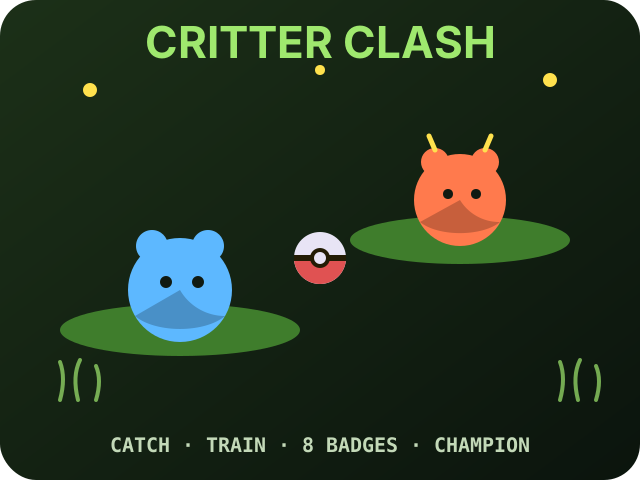
Catch weakened wild critters with capture balls, build a team of four, and beat eight trainers plus the champion with a four-element type-matchup battle system.
MediumPlays here
SonoTap guide
Compare three collection browser games by their actual mechanics and goals. Read practical strategy, learn the differences and choose your next session.
AdventureCatch weakened wild critters with capture balls, build a team of four, and beat eight trainers plus the champion with a four-element type-matchup battle system.
 Casual
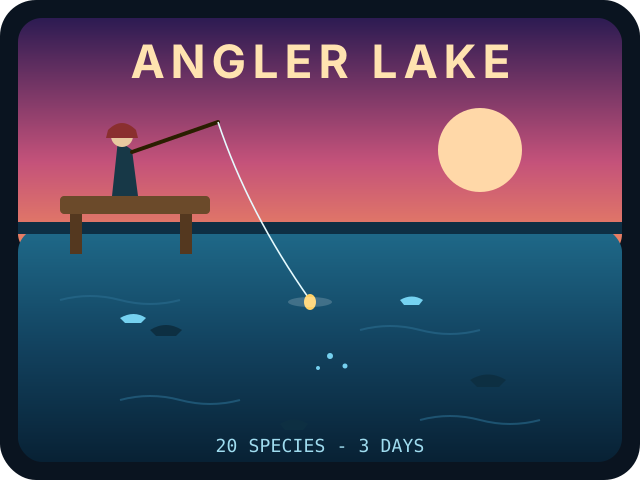
Charge the cast, pick a lure depth, and work the tension bar as twenty species bite by depth, hour and weather; log fifteen in three days to win.
 Casual
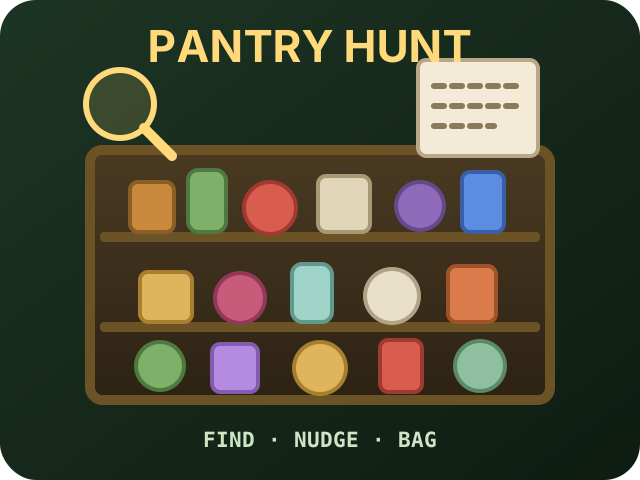
Search a packed pantry for the groceries on your list, nudging clutter aside at a stamina cost while clean finds build a combo across twelve seeded scenes.
Games like Pokémon can mean building a creature team, or simply enjoying an incomplete journal gradually filling in. Critter Clash supplies the creature battles and catches. Angler Lake and Pantry Hunt are explicitly adjacent collection recommendations, not monster battlers. The former asks you to find species under the right conditions; the latter asks you to finish a visible shopping list. None uses Pokémon creatures or assets, and none is an official product or affiliated adaptation. This guide separates the activities so you can choose without opening a game that never intended to provide the feature you wanted.
Critter Clash is a compact monster-collecting battler that squeezes a full catch-train-conquer loop into one screen. You roam a small overworld of paths, trees, and tall grass; stepping through grass can spring a wild critter from a roster of twenty-four species spread across Fire, Water, Grass, and Electric types. Battles are turn-based: each critter carries four moves, damage follows a real type chart where Fire burns Grass, Water douses Fire, and Grass and Electric both punish Water, and a critter at low health is far easier to capture with a ball. Your squad holds four at a time, every survivor levels up and heals after a win, and extra captures still fill the dex. Eight numbered trainers stand across the map with teams that grow from one critter to four as their levels climb, each victory earns a badge, and only a full set of eight convinces Champion Vera at the north edge to accept your challenge. Beating her ends the run in victory; losing your whole team ends it in defeat.
Never throw a ball at a healthy target: the catch formula scales hard with missing health, so chip wild critters down to the red zone with your weakest move first — Tackle exists precisely so you do not accidentally faint something rare. Type coverage beats raw level; a Grass move into a Water foe out-damages a neutral move five levels higher, so build your four slots to cover all four types rather than doubling up on your favorite. Fight trainers roughly in number order, since their levels climb steeply and each badge also raises the level of wild encounters, which keeps your catches relevant. Treat SWITCH as a defensive tool: swapping a low-health critter costs one enemy hit but preserves a team member, and a fainted critter only returns at half health after the battle. Before challenging Vera, deliberately grind grass until your core four sit near level twenty-eight, because her four-critter team punishes anyone who rushed the badges.
Angler Lake is a three-day fishing trip built around a twenty-species journal. Every fish in the lake follows its own rules: a depth band (shallow, mid or deep), a time window (dawn, day, dusk or night) and sometimes a weather requirement, so the Reed Minnow bites anywhere at any hour while the Lake Sovereign only surfaces in deep water on rainy nights. The loop is tactile: hold to charge a cast and release to throw, set the lure depth, wait for the float to dip, hook with a tap, then fight the fish on a tension bar — reel too hard and the line snaps, give too much slack and the hook shakes free. Fish have stamina and burst into surges and sideways runs you steer against with the arrow keys. Catches sell for gold the moment they land, and gold buys four rod tiers, each one casting farther and reeling stronger. Log fifteen species before day three ends to complete the journal and win.
Read the journal before every cast: each unknown entry already tells you its depth, its hours and its weather, so there is no reason to fish mid-depth at noon for a night-only species. Fill the cheap shallow entries on day one and bank gold for the Fiberglass rod, because cast distance gates the deeper bands more than anything else. Rain is precious — several species only bite in the rain, so when the morning roll gives you a wet day, drop everything and chase rain-locked entries like the Glass Eel and Storm Salmon. During fights, tap the reel in pulses instead of holding it flat out; the fish tires while you rest, and pulsing keeps tension in the green. Steer early against a run, not late — the run meter reverses faster when you pre-hold the correct side. Save night hours of the final day for the deep rares, and do not waste them re-catching commons.
Pantry Hunt is a hidden-object game set inside a single overstuffed pantry. Each of its twelve seeded scenes piles dozens of original vector groceries — jars, tins, fruit, cartons, and odd kitchen shapes — into one heap, then hands you a short shopping list of two or three item types, four to six pieces in total. Every requested piece is genuinely reachable: the scene builder keeps each object's center uncovered, so nothing on the list is ever buried beyond play. What makes searching tactical is stamina. Tapping a listed grocery bags it for free, but dragging clutter aside to peek underneath spends stamina, and running dry ends the scene. Three clean finds in a row restore stamina and grow a combo that multiplies your score. Challenge mode gives you ninety seconds per scene; relaxed mode removes the timer entirely. Three PEEK flashes per scene briefly outline every remaining target, and keyboard players can Tab through groceries, bag with Enter, and nudge with the arrow keys.
Work the list in passes rather than hunting one item to exhaustion. A quick full sweep of the pile usually reveals most targets at a glance, and only the last one or two justify spending stamina on nudges. Nudge deliberately: short, purposeful drags that park clutter at the edge of the pile cost the same as random shoves but leave the heap readable afterwards. Protect your combo above your speed — a wrong tap costs more than a careful second look, because the combo both restores stamina and multiplies the scene score. Save PEEK flashes for the final item or for scenes where several targets share a color family. In challenge mode, bag the obvious finds in the first thirty seconds and reserve the rest of the clock for excavation. Learn the item silhouettes across scenes; because the scenes are seeded, a tin you struggled to spot once will sit in the same place next time.
If party building and combat are mandatory, go directly to Critter Clash. The other two cannot replace its team structure. Choose Angler Lake when studying a missing entry and finding its conditions is the satisfying part. Choose Pantry Hunt for a finite checklist inside one scene, particularly when you prefer the mode without a timer.
Set one small objective: broaden elemental coverage without wiping the team, find a rain-dependent fish, or obtain three clean grocery finds before moving clutter. Each makes the next failure interpretable. Check the session limit as well: teams can faint, fishing trips follow a calendar and searches spend stamina. Collection is not automatically risk-free or endless. This shortlist does not promise trading, breeding, a shared online world or the full depth of a commercial creature RPG. The game sections explain exactly what is being collected and what can interrupt the attempt.