 Arcade
Stick Sprint
A minimalist stick run game: your runner never stops, so double jump red barriers, slide under hanging saws, clear gaps, and chase distance as the pace climbs.
EasyPlays here
SonoTap guide
Compare three runner browser games by their actual mechanics and goals. Read practical strategy, learn the differences and choose your next session.
ArcadeA minimalist stick run game: your runner never stops, so double jump red barriers, slide under hanging saws, clear gaps, and chase distance as the pace climbs.
 Platformer
Brainrot Obby is a 20-stage absurd obstacle course: run and jump as Sockodile across floating islands, dodge Toastbirds and red goo, and bank brain cells at checkpoints.
 Puzzle
A keyboard escape puzzle: each of the 12 rooms only answers the letter keys printed inside it. Press E by the elevator, L by the lever, and work out which key opens the exit.
A simple character can hide very different control problems. Stick Sprint moves automatically and asks for quick obstacle recognition. Brainrot Obby divides jumps into stages with platforms and checkpoints. Keyboard Escape uses a small character for a sequence of lettered switches. We separate these choices so a search for stick or obby games does not create the wrong expectation about what your hands will actually do. Each game page explains the objective before you start its local game. None is presented as an official experience from another platform. Decide whether you want rhythm, jump planning or clue reading before choosing by appearance alone.
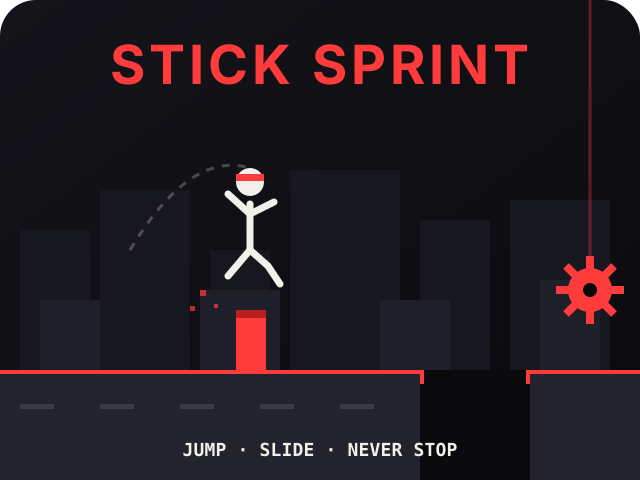
Stick Sprint is a minimalist stick run game drawn in white, red, and near-black. A stick figure in a red headband sprints left to right across a city rooftop line and never slows down; all you control is when to jump and when to slide. Four kinds of red hazard come at you. Low barriers can be cleared with a single jump. Tall pillars leave far less margin and are where the double jump earns its keep. Spinning saws hang from a cable at chest height, so they clip a standing runner and must be slid under. Gaps in the ground need a full jump, and they grow wider the farther you go. One touch of anything ends the run. Distance is counted in meters, the speed multiplier climbs steadily toward about 2.2x, and obstacles spawn closer together as you go. Your best distance is saved on the device, and a Daily Seed Challenge starts everyone from the same date-based seed.
Read each obstacle by its shape the moment it appears. A short block is a single jump, a tall column is a jump plus a double jump at the peak, a disc on a cable is a slide, and a black hole in the ground with red edges is a long jump. Do not double jump by reflex on short barriers: if you burn the air jump early, you have nothing left if you misjudged a gap. Fast-fall is the hidden skill of this stick run game. After clearing a tall pillar, tap Down to drop back to the ground sooner, because the next saw may arrive before a normal landing. Start slides a beat earlier than feels right; the slide only lasts a little over half a second, and jumping out of one cancels it. At higher speeds, nudge the runner back with Arrow Left to see obstacles a fraction sooner. In the Daily Seed Challenge, everything before your first double jump repeats exactly on every attempt that day, so learn that opening and save the air jump for when you truly need it.
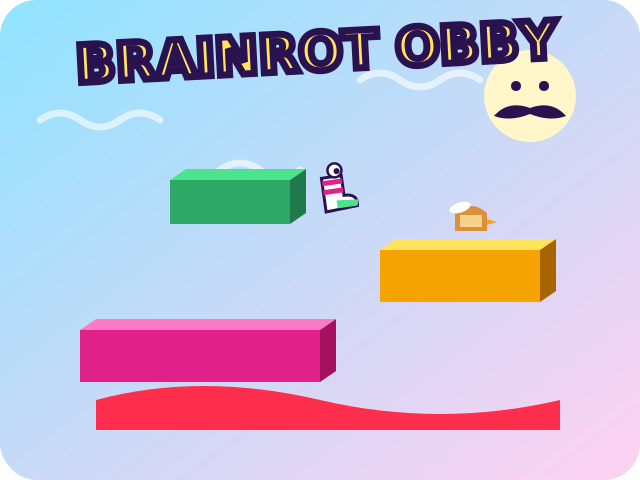
Brainrot Obby is a 2.5D brainrot obby platformer built around one joke that never stops being funny: you are a sock with a crocodile jaw, and the sky is full of noodles. As Sockodile you run and jump across 20 stages of floating candy-colored islands, with the Mustache Moon watching from the background. Each stage chains together obstacle segments: plain gaps, staircases, red goo strips, Toastbird patrols, vanishing platforms that collapse under your feet, sliding platforms and bounce pads that launch you to high ledges. Bagel Knight flags act as checkpoints every few segments. You start with seven brain cells; each death costs one and respawns you at the last flag, and clearing a stage earns one back. Lose them all and the run ends. The finish pedestal on stage 20 holds the giant brain trophy.
Treat vanish platforms as pure momentum checks: never stop on one, and land already moving toward the next island. For sliding platforms, watch one full cycle before committing; the platform pauses at each end, and that pause is your boarding window. Toastbirds fly a fixed patrol, so count their rhythm and cross just behind them rather than trying to outrun them forward. Spend brain cells aggressively on stages one to five to learn the segment types, because stages are assembled from a shared pool and every pattern you learn reappears later with harder neighbors. When a stage mixes goo strips with bounce pads, aim for the pad's center so the arc clears the goo entirely. Finally, short hops are a real tool: on stair segments, tapping jump instead of holding it keeps you low and fast, which matters once vanish platforms start chaining together.
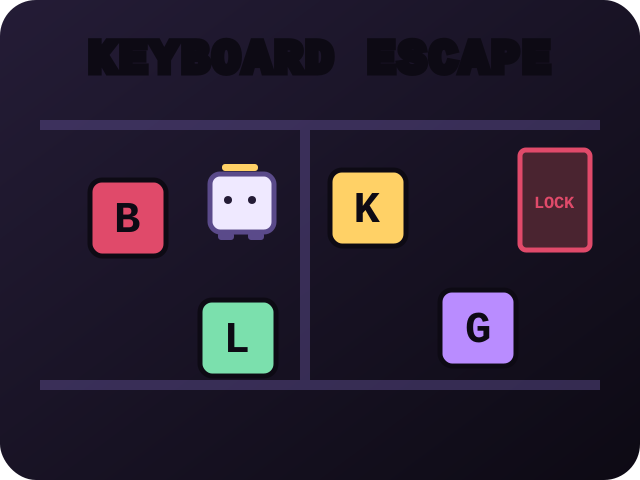
Keyboard Escape is a keyboard escape puzzle with one strict rule: a room only listens to the letter keys printed inside it. You play Caps, a walking keycap, trapped in a twelve-room complex where every room holds a handful of lettered switches — a red B button, a green L lever, a gold K key, a blue W wheel, a purple G gear, an orange F fuse — and a locked exit. The switches only respond in one hidden order, and the hint banner above the room states that order in plain words if you read it carefully. Press a switch out of sequence and the room resets every switch and docks your score. A 75-second timer pressures each room; running out costs one of three focus points. Clear room twelve by riding the E elevator and you escape with a bonus for every focus point you kept.
Read the hint banner before moving a single tile — it literally names the order, so the real puzzle is routing, not guessing. Plan a walking path that visits the switches in sequence order without backtracking, because the timer punishes scenic routes more than the mistake penalty does. In rooms with central wall columns like Three Columns and Crossed Wires, the floor splits into regions joined by one or two corridors; identify the corridor first, then decide whether to route through the top or bottom of the room. Space is faster than hunting for letter keys once you know the order, since it always uses the adjacent switch regardless of which letter it is. If you do trigger a wrong-order reset, do not panic-press: the sequence is back to step one, so walk to the first switch and rebuild calmly. Save focus by abandoning a botched route early — sometimes resetting the room on purpose with a clean plan beats limping to the door with ten seconds left.
Choose Stick Sprint for short feedback loops: one misread obstacle quickly ends the sequence. Brainrot Obby offers more scope to repeat a section because flags reduce the distance lost to a fall. Keyboard Escape changes the pace when you still want a clear decision under pressure without another series of jumps.
Separate observation from execution. Jumping toward a hanging saw is a wrong decision; choosing the right jump a fraction late is a timing problem. They need different practice. Watch a moving platform from stable ground, and read a letter-room clue fully before pressing its first switch. On a phone, keep the character visible and confirm that the essential buttons are reachable. Metres travelled, stages completed and rooms solved are different results, not interchangeable scores. Choose the mistake you want to understand rather than assuming the game with the fewest visual details must be easiest.